Wednesday, February 22, 2017

Believe it or not

What happens when information becomes increasingly less credible?


Fed; filtered; fake; false and alternative facts are words increasingly being heard in relation to news and other information sources. Even the recognised bastions of credibility and authority are no longer immune.

I have spent most of my life involved in and close to news. I cannot remember a time when information conveyed by popular and niche media has been received with such scepticism. This could be healthy if people were encouraged to do some cross checking, but that seldom happens and most prefer to either accept or reject depending on their own drawing bias. For a split second, however, even false information is believed and when it is proved false, the effects linger. In the end, divergent views are cemented and even polarised, creating greater disharmony when it should be doing the opposite.

There are many reasons for this, including the explosion of information technology and information overload. The results are predictable: purveyors lean towards immediacy, populism, headline hysteria and a bit of truth stretching; while audiences or readers orientate towards information that confirms or does not challenge their beliefs. A free flow of credible information is the thread that holds the social tapestry together and the ultimate nutrient for a functioning democracy. Today it is more likely to tear it apart. When knowledge is no longer a guarantee of enlightenment and insight, distrust becomes entrenched not only of sources, but of institutions and each other.

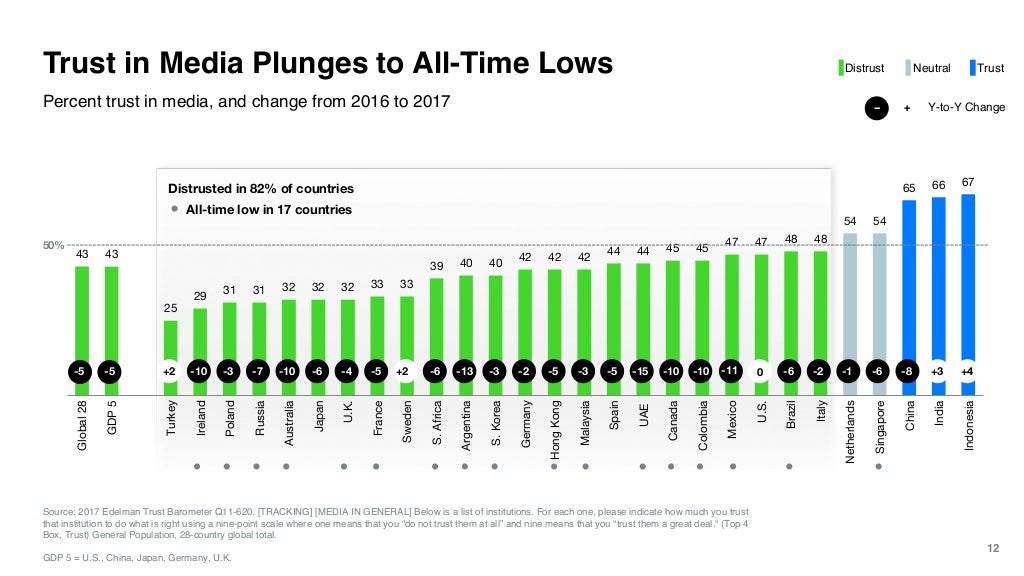
In a recent article (see here), I touched on the implosion of trust in the establishment globally. One of the biggest declines was trust in the media. Of the 28 countries measured in the latest Edelman Trust barometer, the media was distrusted in 82% of them and is at an all-time low in 17. (See graphic here.) 

At a 39% trust score, South Africa falls into the category where most distrust the media. Yet trust in the media is still significantly higher than in countries such as Sweden, France, the U.K., Japan and Australia.

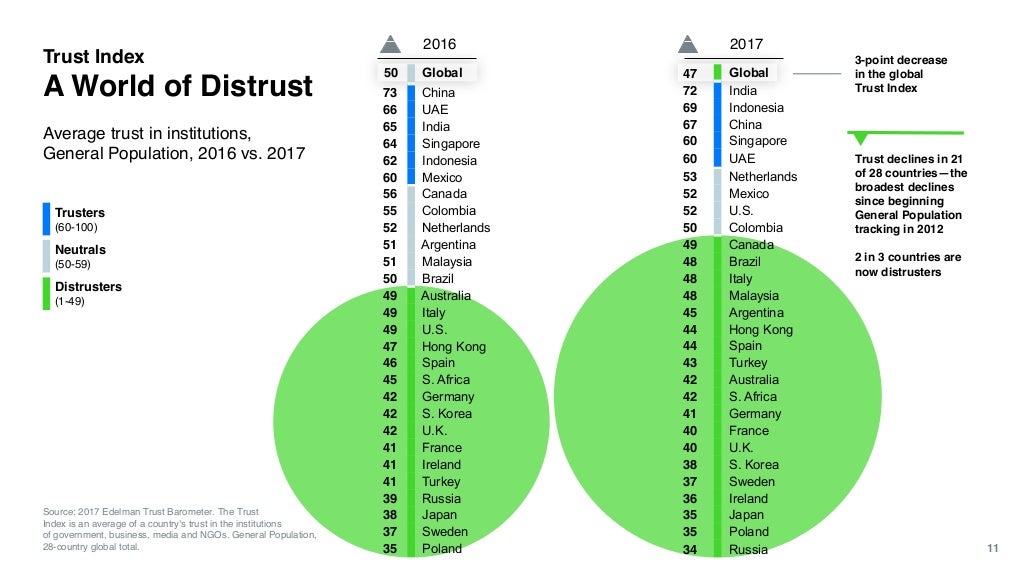
A similar pattern emerges with general trust in the institutional categories of government, business, media and NGO’s. (See graphic here). There has been a sharp decline in trust generally in what Edelman describes as a “World of Distrust”, and its global trust index shows that less than half of the population trust the establishment they live in.  Trust in the United States was just over half, but that was before the election of Donald Trump as President. Trust in South Africa was measured at 42%, the same as Australia, and better than countries such as Germany, France, U.K., South Korea and Japan.

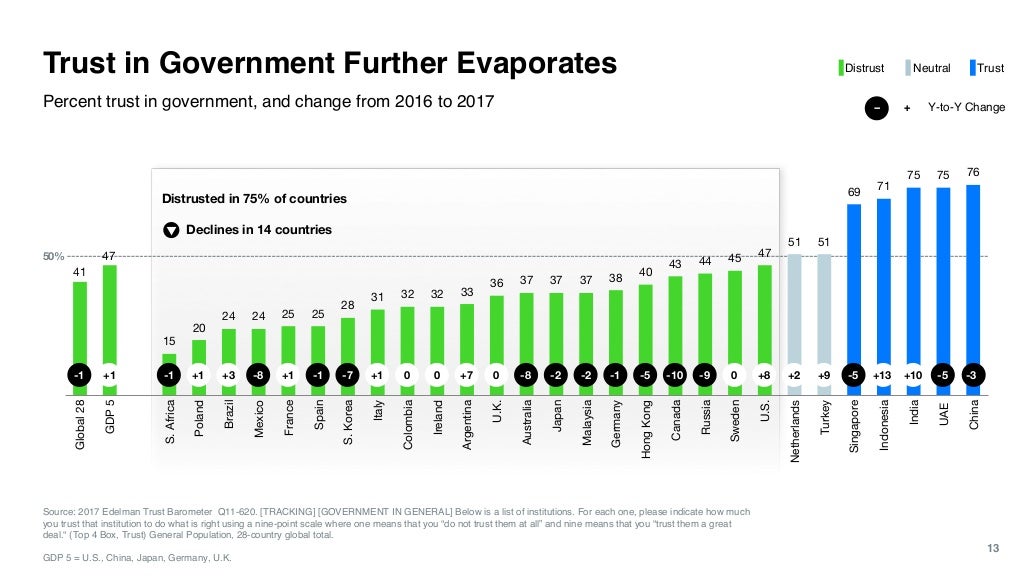
But at only 15%, South Africa still has the lowest trust in Government of all of the polled countries. (See graphic here.) At 76%, China heads the pack of most trusted governments, followed by the U.A.E., India and Indonesia.

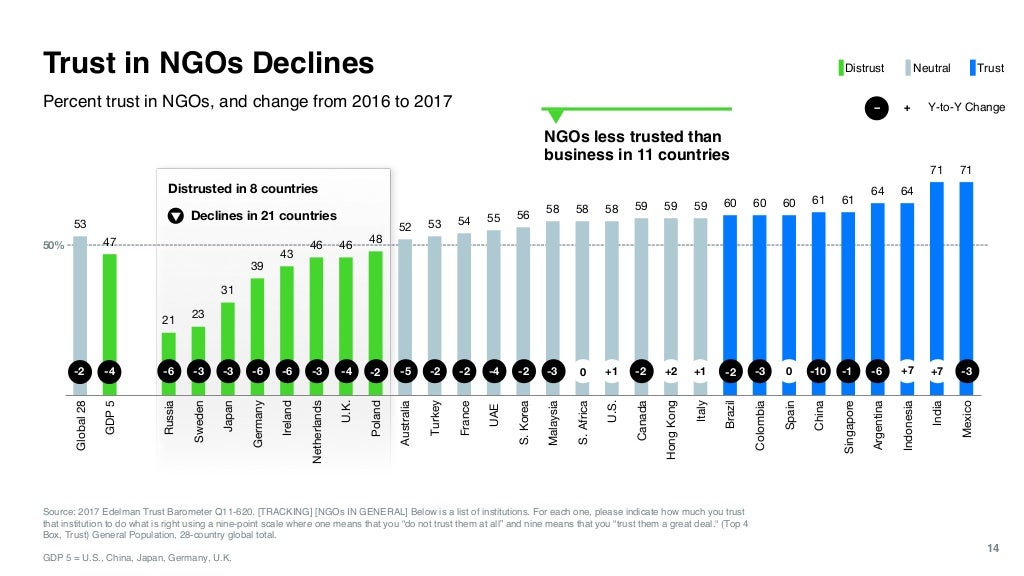
If N.G.O’s are often seen to be doing what governments should be doing, then by and large they are better at it. (See Graphic here). At 53% globally, they head the list of most trusted institutions. Of course, that is still a rather low score and has declined over the past year; indicative of the paltry state of trust in the establishment world-wide.  South African NGO’s fared better than the global average at a 58% trust score.

Business too is generally trusted more than government and the media. (See graphic here.) Although Edelman says it is on the brink of distrust, it still has a trust score of more than half. Of course, if you turn that around and say “nearly half distrust business” to do the right thing, it becomes another frightening indictment of business behaviour, most of which, I would argue again, relates to how business sees its purpose in society.

Trust in South African business has declined by 4% in the past year to 56%. In part, at least, that may be attributable to the ongoing anti-business rhetoric that has become politically popular. But its trust score is still better than the global average and there’s a huge gap between that score and the 15% trust in government. What the populist politicians don’t seem to recognise is that tearing down trust in business is not going to enhance trust in them, and indeed will merely add fuel to disillusionment and ultimate dissent.

After that statistical refrain, let me add that in the last few years the validity of opinion polls has been severely challenged. They are useful only to the extent that they can show trends and comparisons, gaining weight with the sample size, regularity and longevity. But even comparisons, such as the country references in this poll, could be suspect because different communities could have different standards by which they judge trustworthiness.

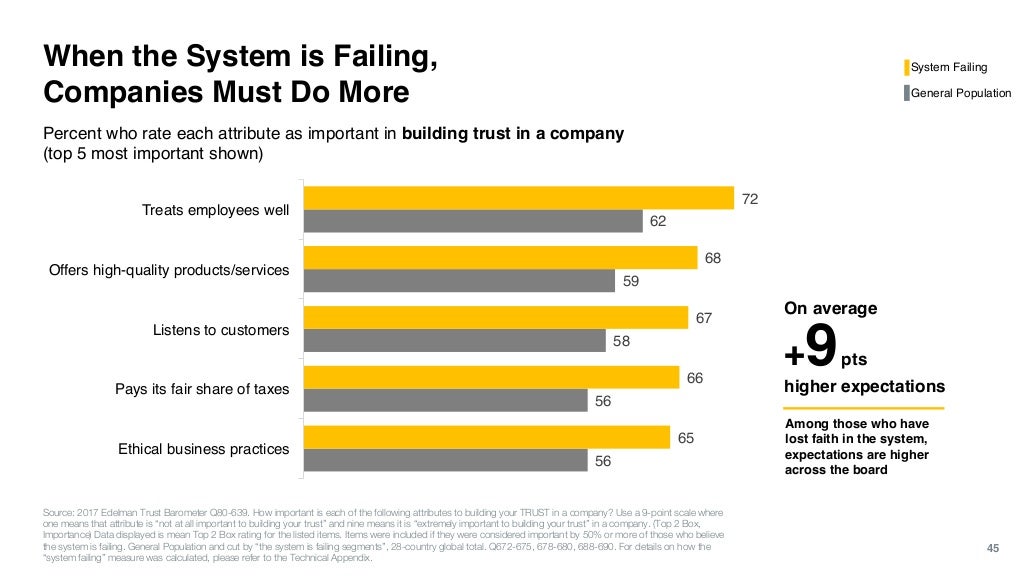
What was more useful in this poll was the question put to the respondents on what business can do to regain trust. It clearly has an opportunity to influence a country’s destiny and secure its future role by enhancing that trust by: (Ranked in order. See graphic here.)

1.     Treating employees well.
2.     Offering high quality products or service.
3.     Listening to customers.
4.     Paying fair share of taxes.
5.     And following ethical business practices.

Judging by responses to my previous article on the shareholder-value driven model, there are some who believe that the best way is business as usual and that the benefits of this model must simply be promoted more convincingly. Only the naïve can truly believe that a model so singularly focussed on self-enrichment of one stakeholder often at the expense of others can engender trust. Ultimately society will dictate in the only way it knows how – “radical” economic transformation through more laws, restrictions and prescriptions. And that by an institution that is even less trustworthy.

For business it’s more than about being nice. It’s about survival.

Tuesday, February 7, 2017

A monstrous model exposed.

The lie that tarnished the best social system humanity has ever created.


Not all lies are based on deceit and malevolence. Sometimes they are based on seemingly valid assumptions but then become a lie when they are fanatically promoted as a universal truth despite clear evidence to the contrary.

There is no better example than the 40 year persistent defence of and slavish adherence to the shareholder-value driven business model; once described by American business leader, Jack Welch as “the dumbest idea in the world.” The model proposes simply that the sole purpose of business is to maximise shareholder value. It found its intellectual and ideological roots in the teachings of American Nobel laureate in economics, Milton Friedman, and is still widely followed, especially by large quoted companies.

But it has had its critics from its earliest days. The latest has been published by the bullhorn of capitalism, Forbes Magazine, in an article by author and columnist, Steve Denning, titled: Resisting the Lure of Short-Termism: Kill 'The World's Dumbest Idea'. It is one of the most comprehensive indictments of the model I have come across and I urge you to read it at this link.  He is not the first. Some years ago Business Insider did a similar analysis, which I captured in a Moneyweb article “Profits of Doom.” Regular readers of this column will be aware that it has been a theme of many of my columns from the beginning.

Apart from Jack Welch, there have been many other critics and Denning mentions a few in his column. In addition, within a decade or so, we saw prescriptions and processes being developed to address the side effects of putting companies on profit steroids, especially short termism. These included the Triple Bottom line, Balanced Scorecard and accounting protocols trying to force business to broaden its view and adopt ethical standards, good governance and sustainable procedures and controls. In South Africa, we have had the King reports. While they obviously have their merits and no doubt have dampened many excesses, they do not, and nor are they expected to change the primary strategic direction of the company. In the end they do little more than treat the side effects of addiction and perhaps dampen excesses.

With the exception of King IV. While the previous King reports address business models, King IV defines a different business world – one where the overall task of business is creating value for all. Again, this is not really new. It was the predominant view before the 80’s. One should also add that not all companies have followed the steroid addicted model, and for most smaller to medium enterprises, it does not make business sense. To some extent this addresses a possible counter argument: that despite its blemishes, the model has promoted many advancements and prosperity. To this I would respond that this is not because of the model, but rather in spite of it.

Adapting to this new business world is a lot easier than one may think, and certainly does not need a huge turnaround intervention. In recently completing the Contribution Accounting Methodology (see here), which is based on decades of exposure to economics, organisational theory and my own consulting work, I was struck by how much of such a transformation is simply doing what comes naturally; is easily understood by all stakeholders, and still makes sustainable business sense. It can be captured in 4 brush strokes, the fine details of which are fully documented in the methodology material.

There should be absolutely no ambivalence that the purpose of a company is to serve its customers. This is rooted in existential logic and the natural laws of transaction. Again, this is not a huge leap and has been endorsed through the ages by great entrepreneurs, companies and organisational theorists. It strikes me that detraction from this truth is because we make no distinction between shareholder interests and company purpose. They are not synonymous. Individual stakeholders may have different motives for being involved in a company, including, but not limited to, maximum profit. But the purpose of the business itself remains creating value for customers. Obviously reconciling individual motives with that purpose has many advantages, including entrenching authenticity.

Nothing is more counter-productive than trying to propose a hierarchy of stakeholder importance. It is divisive and creates conflicting interests. Being loyal to its purpose, a company would clearly see relationships with customers as by far the most important. Stakeholder cohesion and inclusivity are established through a common purpose of service that translates into wealth creation; and a common fate which impacts on distribution such as profits and pay.

For the most part this redefinition would merely imply changing direction. If it is customer driven, it focuses on contribution to its market; if it is profit driven, it focuses on reward. Switching focus from reward to contribution has a fundamental impact throughout the organisation, including improved and more sustainable rewards. Strategy should rest on the three pillars of maximum wealth creation and the 2 of optimum wealth distribution. (See graphic here.)

The “value” in “creating value for all”, is captured in one very simple metric called value-added. It is the outcome of creating value for customers, and is the source of all rewards. It is the centre of an operational Contribution Account which portrays stakeholder inclusivity and a simple presentation of wealth creation and distribution, and from which one can extrapolate all the standard accounts. It embraces the measurements needed for 3BL, BS, and the King prescriptions.

The direct and indirect harm done by obsession with the shareholder value approach has been substantial. Denning gives a superb account of this in his article. For me the biggest harm has simply been the assumption that this monstrous model is an unassailable reflection of free enterprise itself. Criticism of it leads to all kinds of leftist labels. That lie has gone a long way to tarnish the true spirit of free enterprise and its standing in popular perceptions.

It is an aberration and has proved to be the world’s dumbest idea.

Monday, January 23, 2017

The Establishment under attack.

A defining time for business, globalisation and the legitimacy of power. 


There has been a global implosion of trust. The latest Edelman Trust Barometer just released at the World Economic Forum in Davos shows the largest-ever drop in trust across the institutions of government, business, media and NGOs.”
·       Trust in media (43 percent) is at all-time lows in 17 countries.
·       At 41 percent, Government is the least trusted institution.
·       CEO credibility has dropped 12 points to an all-time low of 37 percent.
·       Government leaders (29 percent) remain least credible.

In the many years that I have covered this report for Moneyweb, I have never seen such a dramatic swing in sentiment with well over half of the respondents believing that the “establishment” has failed them. I will come back to this and the South African context in a future column.

The “establishment” has become a buzz-word in global politics. It is a metamorphic concept that in the broadest sense means simply the relationship between power and its subjects. Power manifests in bodies such as global institutions, governments, political parties, courts, religious and social institutions, corporates and companies; or even in sectors and lobbies such as banks, financial services, pharmaceuticals, agriculture, labour, and others. In this understanding we are all part of and subject to the establishment, much like being either a motorist or a pedestrian at different times. 

If the establishment is about exercising power, then its legitimacy will be tested against having the interest of its subjects at heart; whether they are citizens, clients, customers, patients, learners and all others dependent upon a service. And if the Trust Barometer; the widespread anti-establishment rhetoric and the current W.E.F introspection at Davos on responsive leadership are anything to go by, then clearly it is losing that legitimacy.  

The intensity of the anti-establishment sentiment is the only logical explanation for the surprising choice of Donald Trump as President of the United States. It also explains the swing In Europe to nationalist sentiment and Brexit, where the dictates of an even bigger establishment, the European Union, on migration and economic prescriptions were proving to be unpalatable to the British people. The bureaucratic power of the E.U. was demonstrated earlier in its ability to ride roughshod over the will of the Greek people and get a government to renege on promises made to get them into power. That magnificent institution that held so much promise, now faces potential disintegration.

The same challenges face globalization. It held much promise and indeed brought many benefits in the spreading of products, knowledge, technology, innovation, medicines and much else. But it has clearly failed in a key expectation: that of spreading global harmony. Because that takes greater regulation and trustworthy political and economic global institutions. This creates an inherent paradox: the more power is concentrated and the broader its effect, the more it loses touch with the people and the less it is seen to represent their individual interests.  

Globalization has another inherent flaw. It has encouraged the free movement of capital, goods and services; but not the free movement of people. The latter has not only created imbalanced human development with large numbers excluded from meaningful participation in economies, but where experimentation with free people movement has been tried, it has led to regression to national isolationism; albeit under the severe test of a refugee crisis.

The free movement of capital has on balance also had unfortunate outcomes. It has exacerbated inequality and put the world at the mercy of a new force in the form of the financial sector, where national policies can be totally negated and, more ominously, national destinies can be affected by the actions of a few speculators. Indeed, as we saw in 2007, the world economy can be brought to its knees by behaviour in this sector.

Corporates and companies have been under pressure to become more inclusive and redefine their purpose to creating value for all. Where capital is concentrated in the hands of the few and focuses mainly on returns, shareholder value and capital growth, sometimes to the point of even damaging its own consumer brand names, then it becomes a highly distrusted feature of the establishment. This is a global phenomenon, giving some credence to the “monopoly capital” slogan we hear every day. Linking it to ethnicity, such as branding it “white monopoly capital” however, is deflective politics, expedient and disingenuous and unfairly puts blame on an identifiable group of individuals; thereby becoming a greater threat to racial harmony than tweets from a beach.

The free movement of goods and services is also anomalous. It is increasingly being subjected to trade deals and regulation that more often than not would run fowl of domestic anti-competitive laws, and represents not the people of the signatories, but lobby groups and vested interests of big corporations and sectors.  Barriers to trade, such as import tariffs and duties are constantly being used to protect domestic interests – again often in the interest of a specific sector or lobby group, and not necessarily in the public interest.

One bizarre outcome of the anti-establishment furore is the effect it has had on the media. Coupled with the decline of print media, the proliferation of on-line alternatives and the growth of social media, there has been an intense attack on the “mainstream media”. I’m not quite sure what this means, apart from the assumption that it is “pro-establishment”. But it seems that for a significant part at least, the real victim of this bare knuckle fight has been journalistic integrity. “Fake” or “false” news, and rumour mongering is spreading to the point where trust in all information sources is declining.

We are all part of the establishment, and at various levels of activity can do much to make it more trustworthy, or challenge misbehaviour by others. Without that, we simply sow seeds of social discord.

Saturday, December 3, 2016

A matter of TLC.

How the essence of our humanity also has the seed of national contentment.


She was weeping on TV news when she recounted the traumatic events of November the 16th. Her name is Thea. She is my sister. My trachea cramped shut as she made all watching the news clip, relive that experience with her: when an armed gang of six, having hi-jacked an ambulance at Eikenhof in Gauteng, tried to break into her home for abandoned children, taking two security guards hostage and kidnapping three of her boys. This within a week of having a gun slammed into her mouth and an amount of cash held for repairs to a water system, being stolen.

Only those that know Thea well, can appreciate the tight maternal bond that she has for all of her 60 adopted and fostered children, equal in intensity and care to that for her own blood offspring. All of them came to her haven – The Love of Christ Children’s Home -- at birth, abandoned and left to die. A total of 800 children have been adopted by others, but a good number have stayed on into early adulthood and Thea has adopted 19 herself.

The most remarkable thing about her is the huge reservoir of indiscriminate empathy she has for her fellow human beings. In an interchange within hours of the trauma, her first words were to ask after the condition of my life partner, who had undergone a hip operation. A week earlier, she had even offered to come and help if we needed her. One simply has to marvel at such a capacity to form so many deeply sincere attachments with others: attachments that inevitably bring much pain – constantly and repetitively.

Yet there is an indefinable power in that state, which places self-interest secondary to others and loses those debilitating and self-destructive egocentricities. Perhaps it is so elusive because it is counter-intuitive to everything we are taught about transaction, about our natural, instinctive state, and the self-gain motive as a key ingredient for success, or the “what’s-in-it-for-me” approach to all interactions. Relationships founded on those criteria will always be strained and distrustful. And we are only beginning to understand that relationships themselves are at the heart of social accord or discord itself.

If the pursuit of happiness, or social contentment is a fundamental state that all societies aspire to; that all systems, policies, institutions and social constructs should have as a primary aim, we are clearly sadly lacking in much of the world, and particularly at home. All of our actions are mostly geared to improving the material well-being of people on the assumption that it automatically creates individual life satisfaction. At the same time we create unintended consequences not only on economic balances, but on expectations. These can have a far greater negative impact on life satisfaction than the measures alone could ever hope to achieve.

It is a subject that has been raised by many, including myself (see article here), and new research and surveys are constantly being added to the many that already exist. There has been a clear shift from the Easterlin Paradox of decades ago which denied the link between individual happiness and prosperity. Today, the latter is not so easily discounted, although one explanation could be the extent to which society has become more conditioned to assume that link through advertising and more intensive consumerism. But the question remains whether national prosperity guarantees life satisfaction and poverty guarantees national misery. Or simply, does money buy happiness? And are national policies too skewed towards reliance on prosperity?

This year’s United Nations World Happiness report confirms that despite some correlation, there is no absolute link between prosperity and happiness. While socialist Nordic countries, with Denmark at the top, still feature strongly, others, such a Costa Rica and Puerto Rico, rank well above much wealthier countries. South Africa ranks 116th. On the strength of the report, the World Economic forum noted: “In the European study, well-being was seen to consist of three distinct elements: 1) life satisfaction, 2) the presence of positive feelings and absence of negative feelings, and 3) “eudaimonics”, the sense that one’s life has meaning.”

These studies will remain less convincing until one can determine a broad common denominator for contentment at an individual level. One comprehensive 78 years-long study by Harvard (see video here) came to a simple yet profound conclusion that good relationships keep us healthier and happier. As Research Director, Robert Waldinger put it: “People who are socially connected to family, friends, and community are happier, physically healthier and live longer.” This cuts right across status, wealth, and living circumstances.

Clearly we would do far better in lifting national contentment by focusing on fostering good relationships, rather than by an exclusive obsession with material well-being. That’s not to deny the latter’s importance, particularly where there is great inequality, but an absence of the former will not only render these efforts useless, but indeed could even make them more divisive and counterproductive. In the economic arena specifically, we have tragically come to view that construct as a functional one, and not a social one. On top of that, transaction itself, the most common form of interaction between members of society, is seen primarily as a means of extraction rather than contribution.

If sound relationships have to extend from the personal to the communal and social, then that understanding has to change. It is one mainly of perception, and not a huge leap to reverse. In the nature of things dating back centuries, supply exists because it serves demand, and transaction gives expression to the cliché that business is nothing more than people serving people – through our employment, tasks, work and companies.

In that understanding it adds an essential ingredient that underpins personal happiness – a sense of meaning. 

Friday, October 28, 2016

The goose and the turkey

A big bird view of an economy and government budgets.


Each time the fiscus engages in a major exercise like a medium term budget, or the annual budget itself, I am prompted to mix some metaphors involving turkeys and geese. They present a perfect picture of how the government, perhaps all of us, view the economy.

Years ago, if you were called a turkey, it could mean anything from being as dumb as they come, to being rather silly. But that’s probably a generational thing, one that would raise the ire of a large number of people whose ancestors created the Ottoman Empire. Today, the overwhelming image of the turkey is one of a rather noisy, ungainly, ugly creature whose sole purpose to humanity is to be fattened for slaughter and fill the plates of a festive table. “Goose” will be remembered by the boykies from Brakpan as a possessive term for female partners. Geese also may have similarly assigned attributes to turkeys, but are not as popular for the pot, have sought after plumage, and of course, are known, according to Aesop’s fables, to occasionally lay golden eggs.

Those rather clumsily concocted images – one of a creature fattened for slaughter, and the other for protection, preservation and nurturing the longevity of golden egg laying, are a fitting analogy for an approach to an economy. By their very nature, governments tend to view all activities in the economy as turkeys, sometimes slaughtering an entire rafter for a massive binge for a few years, at other times struggling to keep them protected from predators from both inside and outside their enclosure. South African Finance Minister, Pravin Gordhan somehow reminds me of a solitary pen protector. But I’m still not sure whether he sees them as turkeys or geese. At the very least, when his income tax coffers are mostly filled by only 10% of the population, from which the rest must feed, he must be painfully aware that he is starting to cull his breeding stock.

But who can blame governments? Is it not a general view we all have of economies and transaction itself -- that they are there for plundering and for maximum self-gain in the shortest time possible? That all people and things – from a close relative to a wild flower in Namaqualand, are there for exploitation and extraction? In behaving that way, we should not be surprised if we feel that way: extracted and exploited – from the double digit increases in medical aid tariffs, toilet roll prices and shoddy service.

To temper that, and to try and ensure some balance in the forces that we ourselves  unleash through this twisted understanding of what makes us human, we create governments without having much assurance, apart from a very imperfect franchise system and some watchdog institutions, that they will not become even more predatory than private initiative and free transaction.

That leads to the choice that has occupied great minds for centuries, as well as conflict ridden streets, legislative benches, political party think-tanks and even war trenches. It is a question I sometimes ask my fundamentalist socialists: “who do you trust more to do the right thing? Governments or business?”

I don’t really need a response. Globally, private enterprise by and large is trusted more than government. In this country the gap is 16% trust in government and 60% trust in business. (See article here). It brings to mind a bit of banter I had with a former Finance Minister, in which I argued that in a utopian economy, he would not have a job.

Of course, that is purist mischief. The real world is overwhelmed by so many blemishes, pressures, fault lines, misbehaviours and imbalances, that it renders useless sound, intuitive and experiential knowledge. One of the unfortunate side-effects of this seemingly endless power juggling between state and business, is that gestures like the business leadership support for Gordhan ahead of the mini-budget, is that it is muted, if not ironic for the largest part of voting population – where business by and large is still seen as the “enemy” in the populist rhetoric of the day.

Which brings me to part 2 of my untold story – a story that in itself should go a long way to restoring business credibility and certainly relieve the facile call by so many to take, take, take from the capitalist cow. The first part reminded readers of the benevolent underpinning of private enterprise in providing society with the goods and services that they need, and under long established, ancient rules of legitimate transaction. Therein they add tangible and measureable value which translates into wealth creation. The fact that this process has mostly misguidedly, perhaps even falsely, been defended under a “profit” or self-gain motive, has done irreparable harm to that noble status. It supports a simple resentful refrain that if you are about taking, then I have a right to take from you! And I’ll do it through my big Boet come budget time.

But the indisputable fact demonstrated by centuries of experimentation, is that private enterprise is far better and more efficient in creating wealth than governments are. What is more hotly disputed is whether they are equally efficient at wealth distribution. Perhaps not as equitably as many would like, but still pretty well within the fundamental logic that the primary aim of sensible distribution is to support wealth creation itself. In that it has to meet the legitimate expectations of ALL of the stakeholders, especially the direct contributors of labour, capital and state; and ensure their continued contribution.

This becomes crystal clear when company figures are presented as a Contribution Account, and in my consulting days, in presenting these figures in company workshops, I was always amazed at the attitudinal shift it could effect. These workshops have now been converted into off-the-shelf transferable products that can be viewed here. In the dire need for stakeholder cohesion, and a broader understanding of this precious construct we have, it is unforgiveable to maintain such a narrow view of business that attracts an unbearable burden, whether in enmity, perceptions, tax or regulations. The tragedy is that business mostly has itself to blame.

The essence of part two of the untold story is that in the contribution account itself, demonstrated by years of working with it, and at many sites, labour and state (or government) together derive far greater benefit than capital or shareholders. Unpacking the detail each of these categories portrays a splendid narrative of enablement and empowerment.  Perhaps the fiscus should add this format, extrapolated into national accounts, into their research.

Along with many South Africans, I fear that the geese may have wedged their way to more promising pastures. They can fly you see. Turkeys not so well.

Will those that remain also take flight, with global credit ratings leading the wedge? 

Sunday, October 16, 2016

Clash of generations.

Can business be a greater bridge between hopelessness and promise?


“Every generation blames the one before.”

This opening line of that haunting hit song: “The living years”, by Mike and the Mechanics, and the full lyrics (see here) have a reflective message for all generations, both at an individual and collective level. They assume even deeper meaning, if you add another observation: that every generation hopes to leave the world a better place.

These two pronouncements reflect an ongoing struggle that often leaves the outgoing generation bewildered and deeply saddened, and the new agitated and belligerent.

It is the perpetual struggle of the living years. Rarely do the two mind-sets meet and then only when they face a combined threat to their existence and freedom such as a war or oppression: a reflection of my father’s and my youth respectively. In the absence of these or a state of uncommon national contentment, the young wage war on the old, mostly at a personal level, but often at a societal level. And those of the ageing who have entered the last of their living years, but can remember well their own troubled selves reborn in today’s student stone throwers, try to have their faltering voices heard above the sirens and shouts; when, as the song says: “all of their frustrations, come beating at your door.”

“You don’t know!” we say. “No-one possesses the ultimate truth. No noble end can justify malevolent militancy. Be patient. Your cause is being driven by a third force. You are not being heard because you cannot speak with one coherent voice. You create power vacuums that are filled by two-day hot head wonders intent on spectacle more than compromise. Above all, as much as we all fail to recognize it in a hormone active state, the struggle is as much with the self as it is with others.”

At the same time, we of the outgoing generation have to recognise that we are leaving a world of intolerable imbalances and fault lines. For too large a number, it is a world of little hope, of uncertainty, robbed of aspirational promise, of grudge inducing inequalities and of insecurity. It is fertile ground for dissension, frustration and anger and it fuels extremism and fanatical activism. It will force evolution into revolution. In that, the cause is often not the real issue and can morph from one to another. Being part of an angry mob, whether 25% or less of the whole, is cause enough for a good number and gives a critical mass to create social trauma.

The turmoil for many of the outgoing generation is multiplied by their own internal struggle, by posing at a personal level the same question: whether they are going to leave the world a better place in their sphere of influence. It’s a haunting self-prosecution in confronting mortality; one that imposes a burden of unfinished business; of repairing broken relationships; creating some modest legacy beyond material things for which much has been sacrificed but then abandoned to an estate in the forlorn hope of making up for past neglect, or receiving recognition and gratitude when one is past caring. I have witnessed that many times – in some even to the point of not being able to accept that their time has come and plunging their final living years, months, days and hours into misery.

In sharing my own, I am fully aware that I might be inappropriately narrow and testing the limits of your forbearance in what could be seen as self-indulgence. But at one or other point popular assumptions and the discourse in organisational practice have to change to become a valid and significant contributor to easing tensions.

I have always had a leaning towards interrogating context rather than content. It made me acutely aware of how the critical role of business as provider not only of goods and services, but of purpose and meaning, had been degraded and smeared by atrocious business behaviour, populist rhetoric, perceptions and assumptions. But most of all, by an obsession with reward and extraction rather than contribution. It has largely neutered business as a credible bridge between hopelessness and promise – a bridge that could remove some of the wind from the sails of dissent. I have unshakeable faith that business can reclaim that position and all I have written, done and am still doing has had that as its aim.

That path led to the formulation of an authoritatively endorsed argument, including testimony by retired retailer, Raymond Ackerman, that it is “the way of the future; the whisper of tomorrow”.  (See endorsements here.) The premise is simply that the fundamental underpinning of sustainable business is service, benevolence, empathy and making a difference to others. Acute awareness of the powerful interplay between behaviour and accounting, as well as the need to preserve sound business principles, prompted a questioning of the narrow nature of the final business accounts, the struggle for alternatives and the neglect of a long established format of value-added accounting, or contribution accounting.

It is not complex or even new. It is perhaps more appropriately called “accounting for contribution”. It is about being and doing, not just counting. Above all, it binds behaviour and measurements in a cohesive, harmonious and virtuous circle for sustainable growth. All of this has been captured in books, articles, workshops, interviews and speeches. But what has been missing is conversion of theory into broader application: the creation and widening of a comprehensive methodology embracing already proven application in areas such as employee awareness, involvement, communication, financial transparency, and service orientation; to overall strategy, reward systems and entrepreneurial pursuit.

This has been developed in the past few months into what I have called the Contribution Accounting Methodology, or CAM (see here). Above all, to ensure broader traction, the content had to be made highly transferable and break from the standard mould of high cost exclusivity. That has been my unfinished business. It comes at a time when globally there has been much soul searching about the conventional role of business in society.

While no-one, least of all myself, possesses the ultimate truth, evolution is as much about sharing ideas as it is about experimenting with the new.

Sunday, October 2, 2016

The untold story

Why company reporting fails to counter the assault on free enterprise.

We all have memories that make us cringe in embarrassment. One of mine is when I had to cut short a talk to a group of about 50 accountants of a large paper company, and in my opening, put the simple question to them: “what contribution do you think your company is making?”

I was expecting them to respond with: “producing paper”, or even a visionary “enabling people to record events and share ideas”. That would have been my cue to introduce value-added as the only measurement of that contribution. Instead I was submerged in EVA’s, HEPS’s, NOI’s, NOPAT’s, ROTA’s and RONA’s, and a plethora of other shareholder “goggas”.

It made me acutely aware of how narrow our understanding had become of this magnificent social construct we call free enterprise. So much so that it has led to an imbalanced obsession with immediate self-gain and material rewards. And then exclusively for one interest. For the most part that has been created first by our inordinate focus on reward or outcomes; second by the fixation with measurements, and third by the exclusive target of those measurements. 

What really gave this blinkered view weight is Milton’s Friedman’s argument some years ago that the sole purpose of business was to maximise profit; against another argument decades earlier, by industrialist Bill Kellogg, that the purpose of business was to add value to people’s lives and as a consequence one makes handsome profits. Friedman’s understanding creates pressure on business to contribute directly to state spending such as free tertiary education, against the perhaps disingenuous view that these costs, including corporate tax, are simply passed on to others such as customers and employment.

In what can only be called abysmal PR, we have distorted the better narrative: that of the contribution that has been made. Here tribute has to be paid to Mervyn King’s efforts at establishing the integrated report, which some may view as prescriptive and draconian, but most of which simply reflects what all companies do anyway – not only for shareholders, but for society at large. Unfortunately, the integrated report itself is still the Cinderella of company reporting, still has a primarily shareholder focus, is not widely read, and often submerged in too much detail, conveyed in reams of glossy pages that could rival Tolstoy’s War and Peace. 

What is missing is an inclusive stakeholder account that captures the essence of the contribution that each economic cell makes – an account that summarises the detail of the integrated report itself. This could be the Contribution account, which in turn is a small adaptation of the value-added statement. When one views the term “Contribution Accounting” as an active process or organisational methodology, it assumes a completely new and exciting dimension. (See full dimension here).

I am aware that to most readers I am being somewhat repetitive. But this omission from statutory accounting keeps gaining significance against the increasing political onslaught against free enterprise; the expedient non-recognition of what enterprise really means to us all, the harm narrow reporting has done and continues to do; and the dire need to change the conversation. (See Moneyweb article here).

It is true that there are enough systemic blemishes and misbehaviours by many to fortify its detractors. The monetary mess we are in, financial fault lines, and corporate megalomania have all added to a new ideological warfare. But for the largest part by far, the narrative at an individual non-corporate level is still a good one.

As a final account, the Contribution Account is broad and stakeholder inclusive. It could be called the “integrated account” in the spirit of the integrated report, but the term has already been deployed in bookkeeping systems. What certainly deserves repeating is the need for a reassessment of the power of the value-added measurement itself and challenging its inexplicable neglect in organisational strategy. I have previously labelled it as the majestic metric because: ​
·        It is behind all positive transformation
·        It is the source of wealth
·        It measures contribution
·        It measures reward
·        It links contribution and reward
·        It drives all contributory behaviour
·        It is the base of GDP, the nation's wealth
·        It is the source of profits, wages and taxes
·        It affects all company measurements.

The practical power of the measurement at company level lies first in its calculation of income less outside supplies, and then how to improve it through selling more, getting a better price and keeping outside costs to a minimum. It guides an enterprise into becoming truly market driven which in turn encourages growth rather than containment, employment and increased prosperity.

But then it also tells its own story of the difference the enterprise makes to others, the extent to which it enables those in the supply chain and the multiplier effects that far exceed the value that the enterprise itself has added. These three lines alone: Income, outside supplies and wealth creation, are at the heart of creating value for all. They can be practically demonstrated by all companies and ventures, large and small; cutting through generalised theories, abstracts and averages, debated with detractors and adolescent assumptions about what business should be doing as a social entity.

And if we want to focus on wealth distribution, then let’s at least get that into true perspective. The wealth distribution numbers in the Contribution Account reflect the contribution all three estates of labour, capital and state have made, and the benefits they have received. In most cases, labour and state (or government) together derive far greater benefit than capital or shareholders. Unpacking the detail each of these categories portrays a splendid narrative of enablement and empowerment. If we want to set so much store by metrics, then failing to tell the story behind them is tragic.

It is the better story to tell and it is simply not being told enough.