Tuesday, April 28, 2015

Molefe’s morale boosting conundrum

A mountain to climb for Eskom’s acting chief in improving staff morale.

In the midst of load shedding the past fortnight, we had an unscheduled power break. The fault was reported, a reference number provided and within a short time, power was restored.

This was followed by a rather puzzling sms informing us that we would be approached for feedback on the service provided. Mirth was quickly replaced with pique at the audacity of an organisation that has arguably disappointed an entire nation to recruit any kind of useful feedback from customers on improving service. It was therefore not surprising when the call came to find that it was one of those electronic calls which avoided interaction with another human being. I ended the call after the first key-pressing option.

It reminded me of the article I wrote some time ago on the battle weary efforts of flag bearers of our non-delivering state-owned “empires” in trying to keep customers happy. I recalled at the time, the incident in which an Eskom employee parked on a Swellendam street was severely berated by a local resident on the other side of the street and with creative expletives only indigenous Overbergers have mastered.

Therein lies Brian Molefe’s challenge – boosting morale with a severely tainted brand. The two are closely linked, something Molefe seems to have recognised in a Moneyweb Radio interview (see here). He appears to have also appreciated the need to embrace leadership at all levels.

It is often too lightly accepted in conventional organisational theory that an inspired top leadership can infect the general workforce. As important as it is, in large organisations this inspiration more often than not simply hits a solid wall of resistance at the most critical leadership of all – that band from first line supervisors to middle and senior managers. Even where workers at the coal face are motivated through a plethora of costly smile courses, team building break-aways, rah-rah events and happy working conditions, that tired, cynical and stubborn lower leadership group often seems to have its own agenda, rife with resentment and scepticism.

It’s a phenomenon I became acutely aware of in my 15 years of consulting on employee involvement in companies. Armed with background in organisational theory after a stint at Templeton Management College at Oxford, I became involved with and exposed to an overwhelming number of Human Resource orientation and inspirational interventions and processes, many of them simply packaged franchises from abroad. An earlier era saw the birth of a massive new consulting industry, with previous accounting management consultants entering the much more lucrative field and the growth of big and powerful company in house departments.

Large amounts of money were thrown at the “people” problem, with new “stakeholder” concepts proliferating the field. Ironically, all this happened at the same time as the growth and grip of the shareholder value approach and the obsessive focus on maximising returns on capital. In turn this has led to an intolerable contradiction: despite all the time, effort and money and all the smoke and mirrors which modern human capital doctors employ to convince their paymasters that the two approaches – maximising returns and involvement of labour are compatible, labour generally and globally has never felt as besieged as it does today.

One of the myths that is often peddled in costly interventions is that “happy people are involved people”. This is simply not true. Camaraderie in the workplace on its own does nothing for productivity. At one stage, for example, a financial institution was ranked as the “best place to work for” in South Africa. At the same time it was losing customers in their thousands. At a more mundane level, I remember once trying to enter a discount store in a mall well after opening time. The glass doors were locked, although I could see the staff huddled in a group inside the store. The security guard informed me that “they were having a team building meeting.”

I can relate countless more examples, but suffice to say that too many of these highly costly, lengthy and disruptive interventions either achieve very little or when they do, they are seldom sustainable. Ultimately the key to employee involvement lies in that which I have written about countless times: commitment to a common purpose. The only indivisible common binding factor in any organisation is its service to the customer, the community or society. Even that irascible first line supervisory and middle management band can be drawn into such a purpose and strengthen it by ensuring that their subordinates are enabled and empowered to contribute to it.

We keep on insisting that the primary purpose of all of those involved in an organisation is material self-gain. Not only does this appeal to the worst in staff, but it is a divisive force in the way it is constructed in companies. Yet it need not be. By following principles of common fate, in which rewards are differentiated yet flexible and directly linked to wealth creation emanating from the common purpose, it becomes the ultimate force behind employee involvement.

It is quite simple: human beings have two instinctive and primary driving forces – purpose and provision. Both find expression in the working environment. But when provision completely overwhelms purpose in that environment you destroy morale and encourage conflict.

Employee awareness, understanding and transparent communications are natural, logical, inexpensive and classical methods of solidifying employee involvement, willingness and commitment. They can fruitfully replace any of the song and dance hype-filled distractions that have become regular flavours on the consultant’s menu.

In addition to his undoubted prowess as a game changer in large SOE’s, Molefe may find some comfort in the miracles which staff are capable of performing in turning around ailing organisations – from the design by American labour leader Joe Scanlon of flexible pay to save his employers; to the Ohio employee buyout ventures. The difference there was that the initiative came from labour themselves, but the similarity is that staff came to the rescue when all hope was lost.

In many other respects, Eskom may be fundamentally different, but clearly Molefe has to have the entire workforce solidly behind him. In that he has the difficult task of rebuilding without PR spin the Eskom brand as soon as possible. This has to go far beyond a clichéd “we are doing our best under the circumstances”.

A good brand is an essential tool in motivating staff. Indeed it is the only one that counts.

Tuesday, April 21, 2015

Of burning shops and falling monuments

Forming factions to inflame polarisation in a diversified society.

The world is at war. It may not involve direct conflict between super-powers that will deny current turmoil the description of World War III but you would be hard pressed to find a place in the world where a war or factional skirmishes are not taking place, or where it is not affected by neighbouring turmoil. (See summary here.)

In numbers of countries and people involved it may be approaching in human desolation that of previous world wars. The entire Middle East for example, is now fully at each other’s throats, from Pakistan and Afghanistan in the East to Saudi-Arabia in the West, spreading over to most of North Africa and further south into sub-Saharan Africa. Yemen has become the latest country to be embroiled in a full scale civil war, dragging in ten other countries in a coalition against the Houthis, including Saudi Arabia, the Gulf States and Morocco. If you add Russia and Ukraine; the spill over effects of refugees flooding into Europe, and the involvement of the United States, Britain, Europe and Russia either directly or indirectly, then much of the globe is involved in armed conflict.

Millions of people have perished in the past five years and tens of millions displaced and forced into severe deprivation. In Syria alone some 250 000 have been killed, and more than 10-million displaced.

It’s an onion of many layers, which may explain media fatigue in its coverage and an inability to take a satellite view of the turmoil, connecting the dots and identifying a common thread. On the surface, they all seem to be separate: sectarianism involving Sunnis and Shi’ites; religious fanaticism such as ISIL and Al-Qaeda; other factional skirmishes or simply just popular rebellion for regime change often involving super-powers and leaving even greater devastation in its wake such as in Iraq and Libya.

One can only marvel at our awe of the destructive force of nature. An earthquake, cyclone, flood or tsunami in which tens of thousands may perish will occupy our news headlines for weeks. A biological threat of some virus or epidemic such as Ebola will likewise capture our attention, with each new case justifying a headline, closing airports and disrupting travel. Apart from the 5 great extinctions, none of our more frequent natural disasters can compare to what we do to ourselves. Nature is far kinder to human beings than they are to each other.

Close to the core of that onion is something very near to a virus. It is factionalism – that force which forms groups either out of fear or fervour, inevitably creating defensive groups in others and ultimately pitching themselves into open conflict; as deadly as any epidemic nature can inflict upon us. Polarisation presupposes the forming of factions. They come in many guises such as cross border sectarianism; religious convictions and extremism; nationalism; patriotism; racism; tribalism; xenophobia and even political parties and rival trade unions. What they have in common is the extrapolation of unbridled individual self-interest to a group united under a self-righteous flag. They are also very susceptible to manipulation of individual willpower by fanatical leaders or despots.

In the majority of cases factions are an expression of our survival extinct at the expense of the more noble instinct of empathy. They inevitably reflect the worst in us, not the best. Of course it could be argued that forming factions is in our nature as social beings. But we should also see them for what they are – potentially serious threats to social cohesion. To prevent them from becoming radical, their concerns have to find some expression in the more benign social formations.

Factionalism will thrive in an environment of marked material disparities, especially where privilege is perceived to be linked to simply being a member of another faction or group, including race, nepotism or inherited status. It will also finds its roots in history and tradition. There is a touch of cynicism in those who believe that simply teaching history will enable firmer common ground for cohesion. It is not only the way that history has been written and presented that shapes responses, but also its interpretation. Even well versed historians can be in conflict on issues of the past.

Historians often insist that its takes at least a number of decades before events can be placed in proper context. Current events show that this may be an understatement – it could take centuries! Only now, for example, can one start arguing that 19th and early 20th century colonialism may rival the industrial revolution in its impact on the world. Certainly the divisions in the Middle East can be traced back largely to the betrayal of Caliphs and the wanton divvying and swopping of territories between the colonial powers of that time. Most of Africa suffered the same fate because Colonial powers had far greater concern about territory and resources than the interest of indigenous populations.

Factionalism and polarisation have to be contained or muted by addressing both current circumstances of hopelessness, purposelessness and despair, as well as behaviour shaped by tradition and different interpretations of history. Much has been written about the first as certainly one of the critical global issues of our time. The second is perhaps more difficult, but life coaches have a simple formula which can be applied at a societal level.

It embraces a principle that one should never allow the past to destroy the future. You cannot re-write your personal history, but you can certainly reinterpret it by reflecting on it, seeing the benefits even from trauma, and carrying the best forward. With that comes an even more difficult task of accepting accountability for the choices you have made.

It may be a substantial, if not close to hysterical leap to link the defacing of statues and burning of KZN foreign owned shops to the human inferno in the Middle East. Perhaps Professor Jonathan Jansen of the University of the Free State is right in his assessment that the monument protestors are a small minority and South Africa has a solid middle class that will sustain stability. The same could be said of the xenophobic attacks in KZN. But factions do not need a majority and democratic and legal restraints to wreak havoc. The monument controversy carries the germ of factionalism, and certainly xenophobia in KZN is a fully blown symptom of the virus.

Given our diversity we may want to question whether in the interest of freedom of speech, public protest and acceptance of realpolitik we are not becoming too blasé about the inherent dangers of humankind’s greatest scourge.

Wednesday, April 8, 2015

Psychopathy and leadership

Should leaders be given brain imaging scans for symptoms of psychopathy?

It may be a bit of a provocative headline but recent research gives interesting perspectives on whether certain leadership positions attract psychopathic behaviour. It’s an easy conclusion to reach when we witness the conduct of some political leaders, but does the modern business not do the same?

The modern business is predominantly seen (falsely in my view) as an institution existing primarily for the material self-gain of its owners or investors. It is overwhelmingly driven by the profit motive and has in the past few decades in effect been dehumanised (see article here) by paying homage to an entity called capital and viewing all other factors involved, including customers and employees as exploitable resources. In recent times this perspective has been greatly enhanced through the growth of big corporations, especially in finance; greater oligarchical centralisation of economic power and the pursuit of maximum returns in the shortest time possible – also called short-termism.

This may sound excessively disparaging of the modern business, but even if we remove innuendo, that description will fit modern organisational theory and practice.

The leader clearly has to fit this remit and be convincingly able to chant the mantra: “It’s not personal; it’s business.” He or she has to be focused fully on shareholder value to which end he or she is rewarded handsomely (some may argue excessively) in achieving profit and investment performance criteria. Even where these are tempered by law, governance and ethical requirements, the latter are viewed as constraints that have to be managed, if not exploited to become a competitive edge. Everything is viewed as resources that have to be managed and squeezed to ensure maximum returns.

Apart from obvious qualifications such as knowledge, experience (and even ethnic prescriptions in South Africa) modern business executives should have certain personality traits such as strong, at times even ruthless leadership skills; be charming, persuasive, charismatic, convincing, and perhaps even manipulative.

The above apply particularly to those leaders falling into the category of “professional manager” which make up the bulk of executives in business today, especially in the large corporates. In an earlier article (see here) I drew a clear and very important distinction between them and creators and builders in business, those entrepreneurs who have made a difference to our lives and changed the business landscape.

The popular view of psychopaths is a rather scary one: killers, rapists, conmen and criminals. The formal view is just as unflattering, describing it as a “personality disorder characterised by a lack of empathy and remorse, shallow affect, glibness, manipulation and callousness” or someone possessing “superficial charm, pathological lying and a diminished capacity for remorse.”

There is also a scientific diagnosis done under brain scan imaging which reveals that normal mirror neurons which are stimulated to trigger empathy are not activated in psychopaths, but rather disturbingly according Science daily “show an increased response in the ventral striatum, an area known to be involved in pleasure, when imagining others in pain.” It’s been shown that only 1% of the population have this condition, although up to 25% of criminals diagnosed in American prisons have the disorder. So even if they were in high demand, it’s doubtful whether leadership positions contain many of them.

But it is not as simple as that either. Latest research conducted by Dutch neuroscientists (see BBC News report here) shows that while psychopaths do not spontaneously and instinctively respond empathetically to the emotions and distress of others, they have an empathy switch which can be turned on, not by simply witnessing distress in others, but by imagining themselves in that situation.

This gives perspective to the findings of American neuroscientist, James Fallon, a self-diagnosed psychopath who calls himself a “pro-social psychopath” (see published interview here). He distinguishes between instinctive empathy as being “emotional empathy” and the “switched on” empathy as being “cognitive empathy”.

This may explain why psychopaths can be highly effective in any given situation. After all, skilled actors when adopting a character role for a performance can be more convincing than a purely emotionally charged response. In most of us cognitive empathy exists side by side with emotional empathy with psychopaths simply not having the latter. Fallon says psychopaths display some 20 different traits, not all of which are negative or even dangerous. One which is highly sought after in leaders, is called “fearless dominance”.

He believes that cognitive empathy was a significant attribute of many great leaders such as Ghandi, Mother Theresa and Nelson Mandela (his examples). This is not to say that they did not have emotional empathy to begin with; simply that their effectiveness was most likely enhanced by regular use or perhaps even permanent opening of the cognitive empathy switch.

Clearly cognitive empathy is an essential trait for the modern business executive. But if it is not tempered by emotional empathy and guided by a strong clear moral compass, it simply becomes a manipulative tool for self-gain that could cross the line into being severely damaging to others or even becoming criminal. On the other hand, psychopaths, because of enhanced strengths that accompany the condition and who have become adept at practicing cognitive empathy will most likely be more attractive to lead a modern business organisation.

It could be argued then that someone who practices habitual cognitive empathy to the point that it becomes virtually instinctive, will be just as functional, if not more so, than someone who relies mostly on emotional empathy. The real danger is that someone who relies solely on cognitive empathy will be able to switch it off once he or she believes it is no longer needed. This could explain why absolute power often corrupts the holder.

Given our increasing knowledge of the brain and the danger that psychopaths inherently present, a strong case can be made for routine brain scan imaging of any incumbent or potential leader or executive.

Of far greater concern is the extent to which our understanding of business does not require a suppression of emotional empathy. The even more frightening question is whether modern life itself is not forcing humanity to do the same.

Monday, March 30, 2015

Technology and jobs

Is a perverted definition of capital efficiency fuelling unemployment?

One of my favourite economic thinkers is the 19th century French satirist, Frederic Bastiat. And among my favourite sketches of economic absurdities are those dealing with the sophisticated thoughts of Robinson Crusoe and the profound simple logic of his servant Friday.

One such has Crusoe toiling for days on shaping a single board from a tree to construct his home on the island. One day he walks on a beach to discover a perfectly shaped board that has washed ashore from a shipwreck. His delight at being able to save much work is quickly dispelled when he realises that if he uses the board he will be doing himself out of work. So he turfs the board back into the sea.

I had a similar experience when at a mine consulting site there was talk of imminent retrenchments among the surface cleaners. When their co-workers got wind of it, they set about overturning trash bins and strewing the contents about to ensure that their colleagues would remain needed. The mine management’s response was swift in employing motorised sweepers and retrenching a large number of them.

Whenever one raises the question whether technology is contributing to unemployment, there is a knee jerk dismissive response, the most disdainful of which is that it implies resistance to progress and a denial of all the good things that technology has brought us. That clearly is not the issue, but ignoring the fall out of technology is like trying to ignore that certain drugs have side effects that have to be managed. Similarly, the effect of technology on climate change is today widely acknowledged and being addressed – some would argue not seriously enough.

But greater resistance to the question comes from conventional economics, rooted in a very long held belief that far from destroying jobs, technology in all its forms actually creates more jobs. It has been argued for as long as I can remember that workers displaced by technology would find employment “elsewhere”, albeit after obtaining new skills and additional training. That “elsewhere” or “what” is seldom defined, let alone quantified. Even vaguer is how that can effectively be achieved. But the assumption that technology on balance creates more jobs is in itself false.

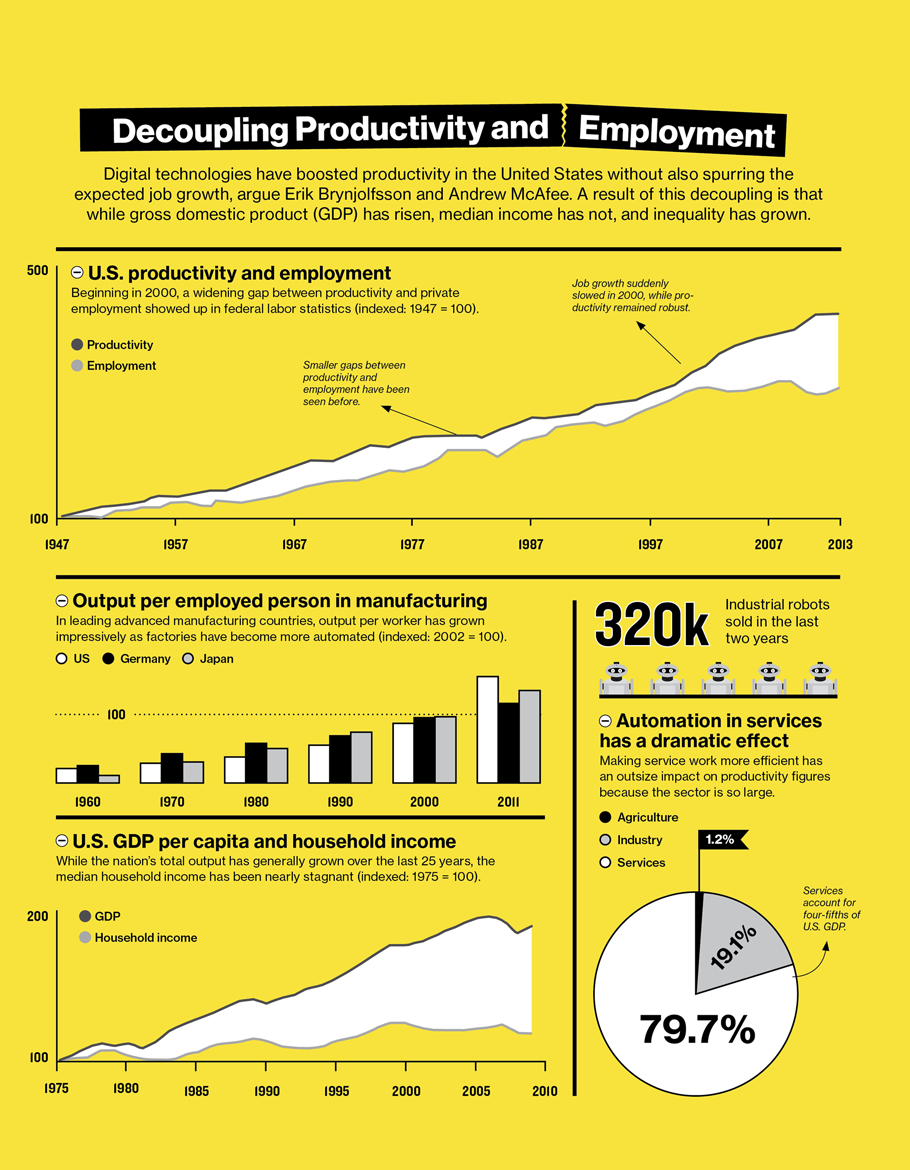
Research by the world leading Massachusetts Institute of Technology (see graph here) provocatively suggests that the opposite could be true, pointing to a growing disconnect between productivity and employment. Productivity gains have outpaced employment since the late 1950’s becoming quite pronounced since 2000. While others in the fuller report (see here) have their doubts about technology on balance actually destroying jobs, the theory that it automatically increases employment simply no longer holds true.

Which may explain increasing public insecurity about the pace of innovation. More than half of the respondents to the latest Edelman survey said they distrusted the speed of development in technology. So if technology is our friend, which undoubtedly it is, why is it also perceived to be a threat? An answer most likely lies in not seeing technology in isolation, but in the broader context of the obsession with the holy grail of capital efficiency, which is the conventional understanding of improved productivity. Bear in mind that the basic measurement of capital efficiency is return on investment. Technology is one element of this. The others are maximum returns on capital in the shortest possible time (or profit maximisation and shareholder value criteria); and investment for maximum short term yields. They are all linked.

Ironically, capital efficiency, especially in the short term, and its main tool of profit maximisation is not always technology’s friend. Technology has two steps – discovery, which is finding or developing a new and creative idea; and innovation, which is putting that idea into practical use. It is often very difficult to find capital supporting untested and new ideas. Even in innovation, the focus on profit maximisation could impede research and development. Developing longer term technology improvements could be stilted by the requirement for higher immediate returns on capital. The latter also specifically targets the involvement of labour as a cost. Clearly the behaviour of labour itself can contribute to that momentum.

It is indeed possible to use technology to improve profits without necessarily increasing wealth creation itself. Simply displacing labour will do that. But the perceived threat of technology to jobs will be reduced when it is seen for the most part as being in the interest of customers and the broader public and not simply to maximise profit.

The third part of capital efficiency, that of investment, has perhaps a less tangible link to technology per se, but in ensuring maximum returns in the shortest possible time, it adds to the general milieu of distrust, unemployment, and income inequalities. This is the diversion of money into highly speculative financial markets and the growing asset bubbles in stocks, bonds and property. In the end there is less motive to invest in people and more in assets.

Capital efficiency is the cornerstone of Western economic thought. This is at least partly due to a lingering perception that profits are equal to value added or wealth created, or even that it is the primary enabler of wealth creation and therefore the most important component of GDP. To challenge its paramountcy borders on economic heresy and most mainstream economists will not go much further than calling for some constraint in its pursuit – if that. I must concede that my definition of capital efficiency may differ from the conventional which relates narrowly to production and not more broadly to organisational deployment such as share buy-backs; mergers and acquisitions; reserve hoarding and investment in flighty global capital movements.

So to be clear, capital efficiency is an excellent tool in ensuring best use of resources. But it is not the only one. Indeed, value-added or wealth created is superior to the narrow capital efficiency focus which should never be an exclusive and paramount purpose. That’s very much like putting an athlete on steroids.

Returns on capital go to the owners of capital, a relatively small section of the population, apart from the highly diluted individual holdings in pension and other investment funds. Ultimately there must be a backlash. If Oxfam is correct in its calculation that soon only 1% of the people in the world will own more than half of global wealth, at least partly attributable to the emphasis on capital efficiency, it poses a real threat to the global economic machine.

It means simply that half of the world’s wealth is mostly trapped in an asset bubble, never to spread in consumption expenditure, that translates into demand and that is the real fuel of production. In short, the more machines and technology replace people, the more tenuous the link between production and consumption, and the weaker demand, simply because fewer people can afford to spend.

Even if we had to overcome that in future decades through some fancy fiscal footwork in redistribution, humanity will confront something most old folks quickly get to know. The two primary challenges in life are provision and purpose.

Without employment, most people will simply lose purpose, perhaps the more important of the two.

Wednesday, March 11, 2015

I don’t believe in “if” anymore.

How hypotheses can cripple national discourse on critical issues.

It seems to be happening more frequently lately: using hypothetical arguments to silence criticism. One of the better known was President Zuma’s suggestion that things would have been better if van Riebeeck had not landed in the Cape. Then there are those peculiar defences of executive bonuses despite poor performances based on the hypothesis that things would have been worse if they were not there. And hypotheses become particularly questionable when used as a veiled threat like “without B.E.E. we would have had a bloodbath”.

Seldom are hypotheses as logical as they appear and even less so do the assumptions that underpin them reflect scientific Newtonian certainty.

So it was with a sense of let down that I saw the technique being used in a vital post budget debate a few days ago, (see Moneyweb report here) featuring a highly respected thought leader and jurist, Judge Dennis Davis, in a spat with another thought leader, economist Mike Schϋssler. The discussion was focused on South Africa’s tax burden, with Schϋssler arguing that we pay a lot of tax and get very little back for it; and Davis countering that this was “profound rubbish” if one considered South Africa as a whole and not only the middle and upper income groups. He then cited a World Bank assessment that South Africa had “the best tax transfer system in the world.”

This assessment has its own context. Apart from experiencing the global problem of massive corporate and other tax avoidance, we have highly efficient tax collection, but being the most redistributive in the world is by no means an accolade, rather a massive indictment. The level of redistribution is never a measure of government success, rather a failure to create the conditions in which people are able to care for themselves. All governments are “redistributive” to some extent, but that extent should be restricted to a minimum.

If “best” means most efficient, then there could be an avalanche of counter arguments. The transactional efficiency of a tax currency is notoriously difficult to measure. In the first instance real measurable value can only be determined in legitimate transaction which means freedom of choice, free moving prices, and alternative suppliers, all of which are absent in government transactions with the electorate. In the second instance, the tangible value of the government’s offering is extremely difficult to measure at the recipient level. Even more difficult is determining the net value after costs of not only collection, but administration and bureaucracy.

So Judge Davis reverted to hypothesis in his assessment of tangible value. He said: “In effect the tax and transfer system has created quite a lot of stability which otherwise wouldn’t be there. Of course it doesn’t go to you (middle and upper income South Africans) but that’s the legacy of apartheid I’m sorry to tell you.” He added: “If the tax and transfer system was to be fiddled with and it failed as a result, political instability could become unbearable.”

So to paraphrase one interpretation: accept the system or face dire consequences.

But to add another equally important hypothesis: the critical yet immeasurable extent to which our highly redistributive government has exacerbated expectations beyond reality and affordability, creating a perhaps even greater threat to national stability.

Even if we accept that the South African government has to be more redistributive than any other in the world, then the question can still be asked whether the beneficiaries of this redistribution are getting value for the money others are paying for. This is the real issue – one that was clearly missed in a facile relapse into rhetoric. The civil turmoil Judge Davis warns about is already upon us – not because of a shortage of tax-payers money to avert it, but mostly because of a failure of government at all levels to do what it is supposed to do with it.

That is not a separate discussion and it is the essence of what irks the average taxpayer and causing extreme frustration on all sides of the income divide. It explains in large measure why South Africa has one of the lowest levels in the world of trust in government among the informed public (17%). So here are a few hypothesis of my own: How much better off would the beneficiaries of tax-payers’ revenue be if:

· The some R60bn in maladministration and corruption annually was spent properly? (It is more than double what the Minister of Finance had to find in extra revenue);

· The R250m spent on Nkandla had been directed to the poor;

· The public service was streamlined to ensure that salaries were far less than the current 12% of GDP, the 6th highest in the world;

And so one could go on. But as we know, the fish rots from the head and something I wrote in a previous article deserves repeating here: The supreme example of an utterly cavalier view of taxpayer’s money is the State President himself. He has surrounded himself with a cabinet of 35 – one of the largest in the world – bigger by far than the United States (16) and China (25), and each costing about R4m a year. Cut that by half (both the number and their pay) and by sheer example alone you will suppress waste substantially, diverting more to where it is most needed.

Any discussion on the collection and allocation of tax revenue has to start here. It is less about what you have, but more about how effectively you spend it. That is ultimately far more relevant to social stability.

But to return to the main issue: the older (and hopefully wiser) one gets, one learns to appreciate the absolute futility of trying to live a life based on “if”, “if only”, “could of”, “would of” and “should of”. Let’s not muddy discourse with their random use.

Monday, February 23, 2015

The end of extend and pretend

Facing up to $200trn in global debt.

They say that the instinctive response to danger is fight or flight. But there is a third – being frozen in awe.

That appears to have been the world’s response to what must be one of the most threatening economic issues of our time – the unprecedented level of global debt. It may also explain the scant attention that the latest data, researched and published by McKinsey Global Institute, has received after its recent release. Collated to cover the main economies of the world, it paints a rather dismal picture of the world’s debt burden.

Debt is to an economy what fertiliser is to a plant. Spreading some around will enhance its growth. A little more may encourage greater growth. But when you get to a point where you are virtually covering the plant it becomes counter-productive. And when you submerge the plant in three or four layers of it, you will most likely kill the plant. When the debt of an economy is three or four times its gross domestic product (GDP), there is little chance that an economy can grow out of it. The production of goods and services is the root of the economic plant and the basis of debt redemption.

That is a frightening prospect. It is rapidly spelling an end to the approach of extending the debt and pretending that it will take care of itself in future. Not all are predicting doom, but a greater number are certainly expressing gloom and real concern about the ability of nations to effectively deal with the problem.

Of key concern is that typically recessions lead to deleveraging, or a reduction in debt levels. This has not happened since the great recession of 2007 and debt has risen by $57trn, or more than 40% to $199trn. Only five nations, the most significant of which is Argentina, deleveraged in that period. All of the rest of the 47 countries surveyed showed increased debt to GDP ratios. Debt now equals 286% of global GDP, compared with 269% in 2007. McKinsey points out that “High debt levels, whether in the public or private sector, have historically placed a drag on growth and raised the risk of financial crises that spark deep economic recessions.”

This is what happened in 2007 and instead of debt reduction we have simply seen a massive increase through monetary instruments such as lower interest rates and quantitative easing. Yet these have consistently failed to pull economies out of low growth, at least in part because of its large application in assets such as stocks, bonds and property, and not fuelling consumer demand or being earmarked for investment in production.

Our inability to learn from the past must be one of the most inexplicable features of recent economics. Japan has had fruitless successive quantitative easing for some years. The US did the same, and it is still too early to conclude whether its recent improved performance can be attributed to monetary policies or simply a natural cyclical rebound. Europe is now also applying these policies and no doubt others will follow, perhaps even some in the developing world such as China.

Increased interest rates are an important tool in reducing debt. While it is generally expected that the US will start raising interest rates by the middle of this year, many would not bet on it. Given the global currency war, the still fragile state of economic recovery and pressure on the Fed, the latter has a good excuse to delay such a move for as long as possible.

image

The McKinsey analysis shows a significant shift in debt from other sectors into government. Government debt has increased by nearly 10% a year since 2007, compared with the 5.3% annual growth in all sectors and less than 3% annual growth in household debt. The world’s biggest debtor nation is Japan at 517% of GDP with much of Europe (apart from Germany) and the US having total debt levels of between 300% and 400%.

The growth of China’s debt, now at 282% of GDP is an alarming addition to severely indebted nations. Most of the developing countries still have relatively low debt to GDP ratios. South Africa is a case in point. It ranks 32nd out of the 47 countries with a ratio of 133% (excluding financial services debt). This was a 19% increase over 2007, with government indebtedness showing the biggest rise (18%) and corporate debt only 2%. Household debt actually declined by 2% and financial sector debt by 3%.

But South Africa also proves the point that statistics on their own say very little. A key consideration is not only the level of debt, but the nation’s ability to pay for it. Given severe structural, infra-structural, energy, labour and government efficiency constraints, the South African picture is certainly not a rosy one.

Clearly the days of extend and pretend are rapidly drawing to a close, if we have not passed that point already. So is calamity just around the corner? McKinsey believes it can be avoided or alleviated. One positive sign is that growth in financial services credit has slowed, specifically as a result of new regulations and controls. It suggests among others the introduction of new tools to create, manage, and monitor debt; better bankruptcy and restructuring processes; asset sales and tax policies that do not unduly favour debt.

Austerity seems to be the only answer policy makers have, but the austerity warriors may also be facing their last days on the battlefield. Already there is such popular dissent against austerity that is has become politically implausible. It has changed governments such as in Greece, and anti-austerity demonstrations have been filling the streets of many European countries including the UK. There is some justification for the outrage. The shift in debt from other sectors to governments shown in the above chart, reflects in large measure bail-outs which now have to be paid for by average tax payers.

It may be stretching a point to connect the dots between increasing economic insecurity and the many violent conflicts across the globe. At the very least austerity and democracy are now clearly in conflict.

Tuesday, February 10, 2015

Profiles and prejudices

One thing we can all do to make South Africa a better place.

It was tempting to rush to the keyboard immediately after the killings in Paris and the inspiring march through the city streets. But I’m glad I didn’t. Because with all due respect to my colleagues in the media, the wallowing in the overwhelming cologne of freedom of speech was somewhat overdone. Of course, it is always an issue but perhaps not the most important in those events and to use Charlie Hebdo as a worthy cause to champion freedom of expression was stretching a point.

“Ah”, I hear you say. “It is not what you say, but your right to say it that is the issue.” Really? Plain old fashioned courtesy is an essential value in our co-existence and while provocation in an environment that can easily be provoked can never excuse a crime, by all principles of jurisprudence and justice it does serve as a mitigating factor. It is reckless at best. But that aside, as the media lets go of its self-absorption, the debate has shifted more to other, perhaps more important issues at stake.

What those events have demonstrated is how deeply entrenched the divisions in our species are, listed in the latest World Economic Forum as the most critical risk factor of the year ahead. As the world continues to forge a global village through mass and social media, trade, international finance, cross border industrialization and travel one would have hoped that these divisions would have become more blurred and the ideals of plurality and multi-culturism more actively pursued.

The dramatic events that played themselves out in the streets of Paris have been seen by many as a symptom of a clash of cultures, “civilisations”, religions and classes. It has become clear in the aftermath that while there was a massive demonstration of solidarity for tolerance, there has also been an extension and hardening of extremism on both ends. But even that is not the full story. (See an analysis by American academic Jeffrey Sachs in Project Syndicate here).

The real crux is that ultimately radicalisation of behaviour is strongly rooted in despair, real or perceived, and often economic, but experienced at an individual level by those involved. The question then is whether society’s responses, including the media, address these root causes or merely serve to exacerbate them. For the media it should perhaps be less about opposition to being muzzled by extremism, but about muting the voice of extremism, not through censorship but by bringing hope where there is despair, alternatives to being radical, supporting the voices of moderation and offering an outlet for the forgotten oppressed. This will never eliminate extremism, but may help in reducing it to a lunatic fringe which is ever present in all societies.

Of course it’s a debate that is always just below the surface of South African society. No doubt there will be some who will fall back on Verwoerdian convictions on the one hand and outdated struggle rhetoric on the other that the current events merely confirm an inherent incompatibly for people of different colours and beliefs to co-exist in a single state.

That horse has bolted. Yet we still cannot seem to focus on common ground but have to reopen old wounds in passing blame or diverting attention from our own shortcomings. We saw that more recently in President Zuma’s blaming our problems on events in 1652, and author Zelda La Grange’s response.

The thought struck me that we will never really achieve any form of harmonious co-existence without individual introspection rather than relying on state or institutional solutions that for the most part actually make the problem far worse, emphasise differences and widen the divide. In the end the most important thing we have is our own individual and personal relationships. This may appear to be a trivialisation of a serious global issue, but if it creates even the smallest shift in individual behaviour, it will serve both society and our personal lives.

We can start by making a clear distinction between profiling and racism – or any other “ism” for that matter. The latter is a deeply ingrained, mostly irrational prejudice that kicks in under any circumstance and is an impenetrable wall against contra thought. To label someone or oneself as being a racist or any other “ist” is unflattering at best. I suspect few of us are genuinely that dogmatic.

On the other hand we all practise profiling. To do otherwise would be to deny knowledge and experience that we have gathered and tested throughout our lives. In most cases it is harmless and malleable – the more it is so the more open our minds and the less, the more closed.

We do it all the time: being a blond female has a certain connotation; having a name like Steve, Paddy or Koos van der Merwe, likewise. We learn to read body language to profile behaviour, and filter our knowledge at source to entrench preferred views. The list is endless.

When we interpret a profile as a permanent, dogmatic state in others, we needlessly generalise and instigate conflict, fear and insecurity and solidify prejudices. More importantly, we harden attitudes to become fundamentalism.

Perhaps the worst form of profiling, and one that should be of particular concern to South Africa, is the profiling of thoughts and views. It is cementing an ideological barrier that is virtually impossible to penetrate in the search of solutions to some of our most pressing problems. Key among them are profiles that become incapacitating slogans such as “monopoly capital”, or more commonly “capitalist”, “socialist”, “Marxist” etc. They are dialogue stoppers.

We can never stop profiling people, things, thoughts and situations. Indeed it can be useful in applying our knowledge and experience. But it is like a filter that has to be constantly cleaned to prevent it from being blocked and preventing further enlightenment.

The trick is simply to be aware of them and constantly test their validity. The British philosopher, William Paley once wrote: “Contempt prior to examination is an intellectual vice, from which the greatest faculties of mind are not free.”

Regularly testing our profiling is not only a great tool in the path to self-enlightenment, but it certainly will make South Africa a better place for all. And it really is such a simple thing to do.